
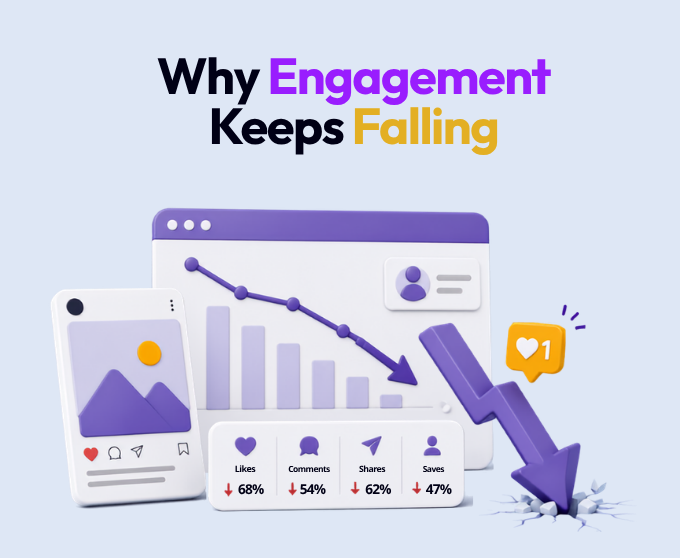
If you have been typing "why is my social media engagement dropping" into Google at midnight, here is the part nobody wants to say out loud: it is not your captions, it is not your hashtags, and it is not because you missed a Tuesday post. Organic reach has been structurally throttled across every major platform, the algorithm stopped treating likes as real currency, and daily posting without a distribution strategy usually means you are just slicing a shrinking pie into thinner pieces. Posting more was never the fix in social media marketing. Posting with intent is.
Most agencies say "stay consistent" and "engage with your community," then move on. That is not an answer, it is a horoscope. Let's decode what is actually happening.
Reality #1: Reach Was Never Supposed to Keep Up With Your Posting
In 2012, an average Facebook post reached about 16% of a Page’s followers. By 2025, organic reach had fallen to roughly 1–2%. Instagram tells a similar story: Socialinsider's own benchmark data shows platform-wide engagement rate sitting under 0.5% in 2026, down from 0.52% a year earlier, though exact numbers vary by tracking firm and methodology.
This is not a glitch, it is widely read across the industry as a deliberate business decision. Every platform you post on for free also sells ad inventory in that same feed, so the more organic content it lets through, the less room it has to sell. Your content is not underperforming because it got worse. It is underperforming because the shelf space got smaller and the rent went up.
If your engagement rate dropped 30% while your industry dropped 40%, you are actually winning. Most brands never check that.
Reality #2: Daily Posting Can Cannibalize Your Own Reach
Here is the part almost nobody explains properly. On LinkedIn, a company page post is initially tested against only 2 to 5% of its followers, and if that small sample does not engage quickly, the post never expands beyond it. Post once, and your best material gets one shot at passing that test. Post daily, and you are running that same small-sample test seven times a week with weaker material each time, instead of concentrating your effort into fewer, stronger shots. Buffer's own 100,000-account study found posting consistency helps up to roughly 20 weeks, after which engagement per post plateaus and starts declining. More volume without more distribution capacity is not growth, it is division.
Reality #3: The Algorithm Quietly Stopped Counting Likes
Somewhere between 2023 and now, likes got demoted from currency to confetti. Instagram head Adam Mosseri has said directly that sends per reach, how often people share a post in a DM, is the best single metric for judging performance, with sends mattering more for new audiences and likes mattering more with existing followers.
Industry trackers commonly estimate a DM share carries three to five times the ranking weight of a like, though Meta has never published an exact coefficient, so treat that multiplier as a directional estimate, not an official figure. A post with 2,000 likes and no shares can still be outranked by one with 200 likes and a strong share rate. The real question is not "will people like this," it is "will people send this to a friend."
Reality #4: You're Fighting for a Feed That Barely Shows Your Followers
Modern feeds increasingly show content from accounts people do not follow. Meta's own Transparency Center reports that in Q1 2026, only 48.1% of Facebook feed views in the US came from friends, joined Groups, or followed Pages, meaning most of what people see is now algorithmically recommended, not chosen. Follower count matters far less than the retention and interaction quality of each post.
So What Actually Moves the Needle in Social Media Marketing Right Now?
This is where "post every day" gets replaced with something that actually works.
- Chase saves and shares, not likes. Ask before publishing: would someone screenshot this or send it to a colleague?
- Post for capacity, not calendar guilt. Format and quality consistently outperform sheer frequency, so one well-researched post can beat seven rushed ones.
- Optimize for watch time, not views. Video and carousels people finish signal quality far more than raw impressions.
- Drop the volume-game mindset. There is no universal magic posting frequency across platforms, industries, or account sizes. Consistency of quality beats quantity almost everywhere.
- Build owned channels alongside social. Email and SEO content are not throttled by a platform's ad model. Social should feed them, not replace them.
The Bottom Line
Your engagement is not dropping because you are lazy or off-trend. It is dropping because the economics of the feed changed, the scoring system changed, and most brands never updated their social media marketing playbook to match. Posting every day was good advice in 2015. In 2026, it is just noise unless every post is engineered to be saved, shared, or watched to completion.
At Creative Nerds, we do not chase vanity metrics, we reverse-engineer the signals that actually move brands forward. Smart ideas beat big budgets, and a well-placed algorithm hack beats a hundred forgettable posts.